Cost, cost, cost. Point to a cost-effective, new-build nuclear in the USA and SHOW me that it's more cost-effective than renewables or LNG.
Until we have a carbon tax or a massive policy shift in favor of extremely capital-intensive new-build nuclear, we will continue on our current path of renewables, batteries, and LNG dominating the grid.
I'm all for nuclear, by the way, but let's not pretend that cultural attitudes (which haven't dented GOP denialism) and misinformed lefty greens (which haven't ended fracking or coal) are to blame here. Nuclear is just way too expensive and hard to do in the USA, it's as simple as dollars and cents.
Yes, nuclear power is less cost effective than fossil fuels. But nuclear, when built at scale in serialized production, can be cost effective. France generates it's electricity at half the cost of Germany, while simultaneously emitting less carbon. The total cost of the nuclear transition program was 400 billion 1993 francs which is ~150 billion USD according to my conversions: https://www.world-nuclear.org/information-library/country-pr...
One of the crucial things to account for is that nuclear's cost is overwhelming overhead cost. So prematurely closing plants vastly inflates the price of nuclear power. This is why nuclear energy costs are so much more expensive in the US, Japan, and Germany. These countries prematurely closed nuclear plants, thus increasing $/MHW.
There are nuclear reactors closing in the US not because of regulation, but because they cannot compete with much cheaper wind and fracked gas sources. There is little difference in operational cost between running a nuclear plant at 50% and running it at 100%. So when they start losing key customers to cheaper power, pretty soon they're operating the plant in the red.
The real interesting part of this is that modern power is so much cheaper that it's less expensive to eat the capital losses and shut down nuclear plants early than it is to continue to operate them.
> There are nuclear reactors closing in the US not because of regulation, but because they cannot compete with much cheaper wind and fracked gas sources
The former is intermittent, and the latter emits carbon.
> There is little difference in operational cost between running a nuclear plant at 50% and running it at 100%. So when they start losing key customers to cheaper power, pretty soon they're operating the plant in the red.
Yes, and we're replacing nuclear plants with fossil fuel plants because of it. When California shut down its second to last nuclear plant, it's carbon emissions from electricity generation rose by 35%. And now we're poised to shut down the Diablo canyon plant with solar during the day and natural gas during the evening.
If we cared about reducing carbon, we'd keep the nuclear plant operating and shut down a fossil fuel plant with the surplus energy.
Market forces do not care if the power source emits carbon or not. We have to deal with that, and I don't like it either. Despite my surface appearance of being anti-nuclear because I point out the irrational, emotional nature of pro-nuclear arguments, I would greatly prefer to keep existing nuclear plants running until end-of-life, rather than replacing them with gas.
But market forces disagree with me.
So what's the alternative? Crushing carbon taxes? That would eliminate the "intermittent" wind and solar solutions that are clean, safe, and cheap, because at the moment they need gas to balance the load. And it would effectively be doubling the cost of energy production in order to subsidize nuclear. And it still doesn't give us an exit ramp, so we'd have to build more nuclear and continue to de facto prohibit solar indefinitely. That's absurd.
What appears most practical to me is taking advantage of gas in the short run to load-balance wind/solar, and eventually moving to energy storage for the balancing, encouraged via increasing carbon tax.
Yes, if we want to eliminate carbon dioxide emissions we should tax or even ban carbon. Why is building nuclear instead of wind and solar "absurd"? France generates over 70% of its electricity from nuclear and it costs them half as much as Germany.
Your wind and solar + gas solution is not a solution. We're still going to be emitting carbon of we are burning gas during the evenings. Energy storage at the necessary scale has not been demonstrated. Nuclear power is known technology. By comparison, solving the energy storage at this scale amounts to saying, "well... we'll figure it out eventually but until then we'll keep emitting carbon."
France is no longer building nuclear reactors. Nobody is, really, certainly not at "do something about greenhouse gasses" scale. The problem is economic. The vast bulk of the cost of a reactor is up-front construction, amortized over 30-50 year lifespans. That requires predictable energy prices, in a market where solar prices dropped over 80% in a decade. There are three different major energy sources all running half the cost of nuclear right now.
This rather impacts the risk of the up-front capital investment. Which affects the cost of the capital upwards. Which in turn makes building new reactors that much more expensive.
We should be building renewables because they're cheaper, safer (please, don't waste breath with nonsense arguments), and far more politically palatable. "Energy storage at the necessary scale has not been demonstrated". Of course it's been demonstrated. It's a problem with a thousand solutions. It's just a matter of getting costs down and production up (which in turn drives down cost). Batteries, thermal, compression, gravity storage... there are so many ways to store and release energy.
I see the "can't store at scale" argument everywhere, and it's utter nonsense, and it never comes with supporting math or facts.
> France is no longer building nuclear reactors. Nobody is, really
The Wikipedia page https://en.wikipedia.org/wiki/List_of_nuclear_reactors believes the following countries are building nuclear reactors: Argentina, Bangladesh, Belarus, Brazil, China, France, India, Japan, North Korea, Pakistan, Russia, South Korea, Turkey, Ukraine, the United Arab Emirates, the United Kingdom, and the United States.
Why would France need to keep building reactors? They're not building more of them because reactors last close to a century.
> That requires predictable energy prices, in a market where solar prices dropped over 80% in a decade. There are three different major energy sources all running half the cost of nuclear right now
And how many of those sources emit no carbon, and deliver power all around the clock? Geothermal and Hydroelectric can, but those are geographically limited.
Solar thermal is zero carbon and 100% uptime, but it's still expensive. Costs are dropping rapidly, though. And as stated earlier, solar + storage or wind + storage also meet your requirements, and are technically viable. It's just a question of cost. Cost of PV solar has dropped so much in the past decade that it could become the winner, even factoring in storage costs. Wind has far less storage costs, because the "What if the wind stops blowing?" theory that sounds so clever isn't really held up by decades of actual data.
We could wait for solar thermal to get cheaper than nuclear (and assume that the cost of nuclear also remains static). Or we could just build nuclear power. The latter has the advantage of having consistent generation regardless of weather and time of year, and consuming a fraction of the amount of land.
Wind power has consistent output over long periods of time. But we still need to make the power grid resilient to fluctuations, which would require immense amounts of energy storage. To put it in perspective how infeasible energy storage is, take a look at California's latest energy projects. The current largest storage plant has 183MWh of capacity, and a planned one has a predicted 300Mwh of capacity[1]. By comparison, the Diablo Canyon plant generats 2,2000MWh of energy every hour [2]. These two energy storage plants can only store 5 minutes and 9 minutes worth of power generated by the Diablo Canyon plant respectively.
Is cost a factor, or is cost not a factor? Pick one. You asked if there was clean, consistent renewable, I gave you solar thermal, and acknowledged it's still cost-prohibitive. But I also expect its cost to plummet as experiments turn to production and lessons are learned.
First of all solar thermal is still intermittent and subject to weather and seasonal fluctuations. It has a built in thermal battery so it's consistent on a 24 hour basis, but it's still a variable source of energy.
Cost is a factor but not the only factor. Intermittency is a factor. Geographic limitation is a factor. Land consumption is a factor.
Cheap intermittent energy is an okay supplement, but cannot reliably deliver when it is needed. Hydroelectric and geothermal are great, non-intermittent clean energy but are impossible to build without the right geography. Fossil fuels are cheap, and deliver power anywhere but emit carbon. Nuclear power isn't as cheap as fossil fuels or intermittent sources. But it's the cheapest non-intermittent source that isn't geographically dependent.
If our goal is to fully replace fossil fuels, then nuclear is the best option (besides building geothermal and hydro where we can). Sure, solar thermal can deliver clean energy without the need for additional energy storage. But we could build twice as much capacity with nuclear and use a fraction of the land, and avoid having to build larger plants in the north and south, and avoid seasonal output fluctuations.
Ignoring clouds, the daily average insolation for the Earth is approximately 6 kWh/m2. [1] So you get about 0.25 KWe averaged daily per m2. Solar has serious land use issues. It is estimated that 1% of the UK would need to be given over to solar to deliver the current power needs. [2]
Noor II CSP delivers 0.66 TWh and is 6.8km2 (200 MW - peak?)
Ringhals Nuclear Power Plant delivers 23 TWh annually (3955 MWe)
A solar plant using the tech of Noor II and the power delivered of Ringhals would be 237km2 - twice the size of Paris.
> It's a problem with a thousand solutions. It's just a matter of getting costs down and production up
Can you source this? I heard of molten salt, gravity storage etc... but I have not read any paper stating we can scale those solution to 50% or even 20% of our current grid usage
Have you read a paper saying we can't scale those solutions? Can you think of a rational reason they can't be scaled?
The problem isn't "can't". Storing energy is trivial. The problem is cost. How much storage is required, and how much will it cost to build it, and how much will that make the total cost of a new energy system?
All this "can't" stuff is, frankly, reactionary bullshit by some very emotional people who are rather in love with the idea of nuclear energy. That's why you never see hard numbers attached to it.
Storing energy is not at all trivial. You want hard numbers? Here are the hard numbers. California's largest energy storage facility, still under construction, is set to have 300MWh of capacity. By comparison, the Diablo Canyon nuclear plant generates 300MWh of electricity every ten minutes. The largest energy storage facility in the world, still under construction in Utah, is set to store between 1-2 GWh of energy. This is still less than what the plant generates every hour.
Electricity to gas conversion has terrible efficiency. 30-40% for the electrolysis and Sabatier process, and then ~50% efficient for the gas combustion engine. Net efficiency is in the 20-25% range. Hydroelectric storage is geographically dependent. Most of the US is in flat terrain.
California said they would do solar and wind plus storage. Then they realized storage was not possible, and they used fossil fuels instead. Similarly, Germany closed down their nuclear plants, saying they'll build intermittent renewables plus storage. And then they ended up building fossil fuel plants when they realized storage could not fulfill the base load they lost from closing nuclear plants.
Why not store hydrogen? Estimated round-trip efficiency is approximately 40%. Storage in underground caverns / mines.
If most of the energy consumption is supplied directly, the storage part need not be overly efficient as long as it can cover the slack. 40% seems good enough. Even 20% is workable, if need be, just need to over-provision enough PV / wind and the over-provisioning itself significantly reduces needed storage.
If combined with capacious long-distance electrical grid (e.g. HV DC), load scheduling, high-uptime offshore wind, some PV in deserts, maybe thermo-electric solar, some batteries for rapid load following, etc, we really can supply enough power even with 0 coal, gas and nuclear power plants, and it wouldn't even bankrupt us. All we need is will. The technology is already sufficient and with improvements it won't be even that hard.
Trying to rely only on intermittent power sources has huge storage requirements due to weather along with daily/seasonal variation. If grid energy storage was a simple problem it would have been done decades ago.
For example, one estimate is that for Germany to rely on solar and wind would require about 6,000 pumped storage plants which is 183 times their current capacity:
>...Based on German hourly feed-in and consumption data for electric power, this paper studies the storage and buffering needs resulting from the volatility of wind and solar energy. It shows that joint buffers for wind and solar energy require less storage capacity than would be necessary to buffer wind or solar energy alone. The storage requirement of over 6,000 pumped storage plants, which is 183 times Germany’s current capacity, would nevertheless be huge.
It can't be true that keeping a nuclear power plant running is more costly than replacing it with a massive capital expenditure. Can it?
The only possible way is if the alternative is massively funded by debt, and the "cost" is based on historically low interest rates and a repayment timeframe in the decades.
Even then, given the ongoing cost of nuclear is relatively small, how is it possible that the capital expenditure of solar + natural gas is cheaper than the running cots of nuclear? Can someone show me that maths?
When something is true, saying "it can't be true" doesn't make it not true. This is happening to existing nuclear plants in the US. Not plans for plants, not plants in construction.
This caught my eye when a nuclear plant in Iowa (near friends, including one who retired from working there) got slated for shutdown, over a decade before end-of-life. They'd lost a key industrial customer that consumed 30% of the plant's output to much cheaper wind/gas. At that point, operating costs went into the red. The plant was no longer generating the revenue to pay off its own debt. It was a purely economic decision.
And yes, the wind and gas that ate its lunch are also capital expenditures, amortized over time. But they're still much cheaper.
However, these systems produces ~30% more power outside of the normal range for solar systems. This effectively squashes much of the duck curve and with the right mix and wide geographic distribution work well with nuclear power and modest energy storage systems.
Technically, this makes the duck curve worse, because the actual "problem" the duck curve presents is solar ramplong down in the evening faster than gas can ramp up. But trackers (or west facing panels) make that more like a square wave so it lasts longer but then falls faster than a static south facing panel.
But, the duck curve isn't a real problem anyway. Worst case scenario, some solar gets curtailed , creating an opportunity for storage solutions.
You’re thinking solar is all in the same location. Across a few locations in even a single time zone the ramp up and down is going to be fairly steady. Also, with nuclear in the mix you can be charging grid storage twice a day assuming a daytime and night time surplus. This possibly cuts the cost per kWh of some energy storage in half.
Ramp up/down is not much of an issue, as long as you can predict it. Yes tracking solar looks more like a square wave, but only in an extent a duck looks more like a horse, than a worm.
The price of power is probably also regulated. You can't really compare France to the US, the French state steps in and regulates pretty much anything.
Germany shows that even if your cost of building a reactor was zero, you could still have the reactor shut down due to other issues.
"Following the March 2011 Fukushima nuclear disaster, Germany has permanently shut down eight of its 17 reactors and pledged to close the rest by the end of 2022." - Wikipedia
Edit: This might just be because Germany is as close to the Ukraine as California is to Texas. Also removed dumb sentence.
The argument here is that we need to streamline the regulatory environment for nuclear, invest in it, and convince people not to fear it, if we hope to make a real dent in climate change.
Solar and wind are great technologies, but they cannot be the sole basis for a power grid without positing some new energy storage technology that does not exist today and for which there is nothing on the horizon.
Nuclear technology has stagnated horribly because of the fears. Even the newest reactors are using old designs because it's impossible to move forward with new ones.
We could have used our educational system in the US to teach people about radiation so they would not be so afraid of it. That would have been great and could have paved the way to the use of nuclear power about 30-50 years later.
I'd like to point out that the current extremely paranoid (and expensive) regulatory environment was brought to you by people who were "taught" about radiation during the cold war. I was taught of the dangers of radiation in the 80s. I kind of just translated it into ways to protect myself against alpha, beta and gamma, but I can guarantee most of my school mates only recall that gamma radiation penetrates a meter thick slab of concrete, and don't want any part of it anywhere near, even at the background levels they are already experiencing when flying to their vacations. These same people also don't realize that a coal fired power plant emits about 100x more radiation than a nuclear plant does, and if asked which they prefer would prefer coal. Even if you tell them that coal is more radioactive, most of them will not change their mind.
You have too generous a view of the ability of an average person to understand and think rationally about such concepts. In the absence of understanding, fear takes its place. This is TL;DR of why nuclear power stations aren't profitable in the US today.
I was discussing a system of education that starts early and is more soft. Like having 1st graders using coloring books with nuclear power plants surrounded by beautiful skies and forests while at the same time having pictures of coal plants belching out smoke that cover everything. Later have a class where everyone uses Geiger counters to measure radioactivity in bananas and talk about how it is all around, all the time, and is part of nature. A bit of indoctrination, like all education, but could have countered the high anti-nuclear content of the general zeitgeist.
Bill Gates was planning on building his new prototype nuclear reactor in China until the recent US/China spat made that impossible. Now he hopes to build it in the US, but it might be politically impossible. I hope that is not the case.
Math matters. Nuclear energy is not substantially cheaper in other countries than it is in the US (feel free to provide cites otherwise) - even countries like China where environmentalist rabble-rousers can find themselves in prison.
This suggests to me that the regulations for the ignorant paranoid treehuggers are not actually the problem.
And environmental rabble-rousers are religious zealots at this point - devoid almost completely of rational thought. The most environmentally responsible option at this point (and in the foreseeable future) is nuclear.
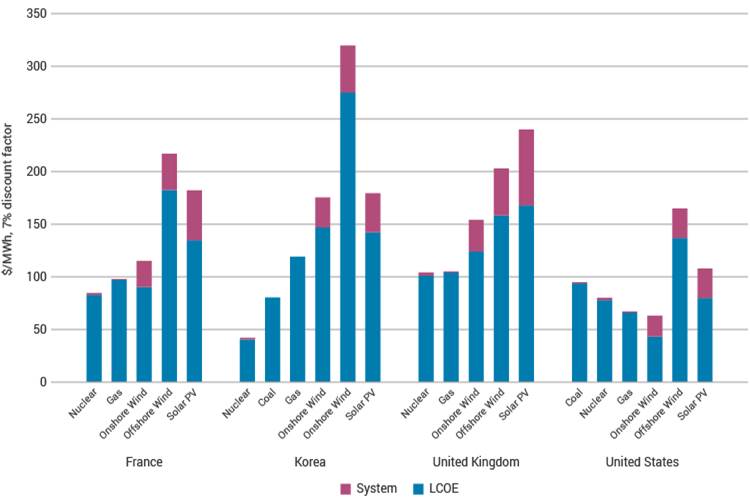
What is the cost of gas in Korea, vs the cost of gas in the US? We're the largest producer in the world. They have almost no gas of their own, and must import.
addendum: I find it striking that this thread is full of people telling me that nuclear costs are high in the US because of the treehuggers, and it's so cheap in France, but according to your chart, nuclear power is actually cheaper in the US than it is in France.
Personally, I think we should stop considering hydrocarbons as a viable power source in the long term. So it doesn't really matter how much gas costs - it should be replaced by a clean energy source regardless of cost. And we should make it economically viable for nuclear (the only currently viable replacement) to do so through a combination of R&D and changes in regulations. Knowing that this will be deliberately misinterpreted for the sake of putting up an argument, I will point out that I am not arguing for more lax _safety_ regulations. Just for removing the fossilized crap which doesn't make much sense from the safety standpoint anymore, and costs billions in compliance costs, making new nuclear construction untenable.
I'm not at all convinced that "regulation" is the cause of high nuclear power costs. I'll note that, per someone else's attempt to rebut me, I learned that nuclear power is cheaper in the US than it is in supposedly enlightened France.
Of course, I completely concur that we should eliminate all fossil fuels from the electric grid, as much as possible from transport, and at whatever pace we can manage from building heating. But I want market forces working with us, not against us.
You mention "currently viable", but then we need R&D to make it currently viable? For how long? Ten years? Twenty? Wind and solar are viable now. Energy storage is viable now.
It is _technically_ viable as a replacement for hydrocarbons. As in, it could replace all energy generation from hydrocarbons, with room to spare. It is not currently _economically_ viable, however. This is what R&D and adjustments to regulations are supposed to help with. But then, wind and solar aren't economically viable either, and everyone is pushing them like crazy.
I think the counter-argument here would be that nuclear is way over-regulated, and that's why it's so expensive.
You could multiply the deaths-per-TWh by 100 from the stats quoted in the GP's link and still compare favourably to non-renewable options, or 10x and compare with renewables. That safety record is very clearly due to the public being (irrationally?) terrified of nuclear anything, and constantly ratcheting up the regulatory requirements.
Most people don't think about the world in this way though. Saying "we should increase the death rate of this technology by 100x" would immediately destroy the career of any politician. "Joe Politician wants 100x as many children to die" would be the obvious attack ad in response.
This is a shame, because if you could reduce the cost of nuclear by 10x by increasing the death rate by 100x (still ending up with a moderate death rate), and in so doing produce a radically cheaper and zero-carbon power source, then you might save thousands or even millions of lives from climate-related deaths over the next century. (To be clear, the "might" is important; I'm not making claims about how much of a win there is by taking this path. In this paragraph I'm making the meta-level point that no matter how much is to be gained from this path, we would not go down it.)
Whose neighborhood do you propose to build these in?
HN talks frequently about how opposed to NIMBYism it is, but I imagine they'd sing a different tune if the politicians told them "yo we ratcheted up the death rate 100x and we're building a new plant near you!"
> Are you arguing we should make nuclear power less safe, then?
I'm arguing that we should look at the cost-benefit of each marginal increment in safety, before dismissing nuclear power as "too expensive".
If you put in place requirements that wind power must kill no birds, forcing them to build expensive bird nets and other countermeasures, you could reach the same sort of conclusion that wind power is too expensive to be competitive.
> What's the advantage of that?
As I said, if nuclear was cheaper, and also not too dangerous, you would displace coal much more quickly (particularly in China). For some values of "cheaper" and "not too dangerous" you would prevent more deaths (by averting/reducing climate change) than you caused with such a policy change.
China is one of my reference points for the cost of nuclear. After all, they don't have democracy's built-in resistance to unpopular ideas (no fear of anti-nuclear activists), and a strong ideological drive toward nuclear, in addition to cost considerations that are real everywhere.
And yet, China is dominated by coal, and not building much much new nuclear capacity, really. That suggests that something other than treehugger political problems are causing the slow adoption. Meanwhile, they're building massive new wind and solar projects. Without checking the numbers, I expect those projects outstrip their planned nuclear in total capacity.
But the real cost of nuclear isn't the cost of safety. It's the cost of capital. And capital is sensitive to risk. So large scale projects with 30-50 year payoff schedules, in the face of new technologies that are already cheaper and continue to drop in cost, and don't have the political/social resistance nuclear does... well, that factors in to the risk. A little risk adds a great deal to long term capital cost.
China is still increasing nuclear capacity. In fact they’re building 11 plants currently (yea I realize you said “much” but 11 new plants is a fair amount) and plan to keep increasing this due to air quality concerns from coal fired plants.
I'm much more sympathetic to this line of argument.
Things I'd like to look into more (and would love to hear any thoughts if you have insights): are there anti-proliferation reasons that mean Chinese companies don't have access to the same level of nuclear technology as USA / France? Are domestic investors less willing to invest in these sort of projects in China (e.g. since there is a major construction boom)? Are international investors less able to invest in these sort of long-range and potentially sensitive projects in China, due to capital controls or other reasons?
But I agree, if China can't affordably build a nuclear plant, then that would at least suggest that the regulatory component isn't enough to explain why it's not cost effective.
China has been building nuclear plants for decades. They have a huge body of practical experience. I don't think "same level of nuclear technology" is the issue, because plants tend to be built with proven tech, not raw research.
Cost is a huge issue for nuclear power. It could sort-of compete with coal, but not with cheaper modern sources. This is a bitter pill for nuclear proponents to swallow. It's easier to blame irrational environmentalists and their unnecessary regulations than to accept that a fetish technology is not actually economically viable.
We should have the same safety standards for all power sources.
You want nuclear to be super-safe? Great, we've achieved that. But we should then apply regulations to wind, solar, coal, etc. that lead to the same number of deaths per TWh as nuclear, including from installation, air pollution and disasters.
If we don't do that, then we're effectively subsidizing the ones with lower standards.
Your "in the USA" part is cheating unless you believe France builds inferior nuclear plants. Nuclear is only uncompetitive in the US because of lawfare at every single step of construction.
France isn't building plants, though. (Technically, they're building one...) And they're life-extending the plants they have now, but that won't work indefinitely, and it isn't free.
I wrote the second article (nextbigfuture) referenced in the nuclear safety citations.
It is irrelevant that the recent nuclear reactor projects in the USA and Europe are expensive. A weighted average of cost and completion times for global nuclear reactor construction would be dominated by the 90% of the nuclear reactors built by China, Russia, South Korea and India.
Do you based your analysis on the price cars based upon the price of a Rolls Royce? Do you price bridges based upon the cost of the Bay Bridge? Tunnels based upon the Big Dig? Rockets based upon the Space Launch System?
Also, nuclear got expensive because constantly increasing regulations and bureaucracy drove up costs in the USA. Reactors without accidents built in China and South Korea for 4 times less. Also, the systemic failure of large construction projects in the US. Skycrapers, bridges, subways and highway costs went up. High-speed rail in California versus China for costs and completions.
China generates as much electricity this year as USA and Europe combined. China will double again within 20 years. Natural gas will dominate US energy mix.
The solar and wind will not scale well beyond 10%. The US will need massive buildout of energy storage and massive energy grid modifications. This will run into the big project incompetence of the USA.
China builds all of it's large infrastructure projects like high speed rail for about a third of what it costs in the States. It might be regulations and bureaucracy accounting for that difference, but it's not specific to nuclear.
I wouldn't call it "incompetence". The US is clearly able to build large projects when it really has to. It's simple third-world style corruption that gets in the way. That's how congresspeople become multimillionaires on $170k/yr in a super high CoL area. Someone should look into that, and it's sure as hell not going to be Congress itself.
It is baffling to me that LNG is often cited as a potential solution to the carbon crisis. It's not. LNG is a hydrocarbon, and burning it releases CO2 just like any other hydrocarbon.
Sure, every little bit helps. But to avoid long-term catastrophe we have to get net carbon emissions down to pre-industrial levels. A 50% reduction sounds good on paper, but it's a trap. Suppose we achieved it. Then what? We're still increasing the overall CO2 concentration, just at a slower pace. That won't help us avoid catastrophe, it just delays it for a while, and probably not for very long. LNG is not a step towards a solution, it's a detour that leads back to catastrophe by slightly longer route.
People don't talk about it, but what killed the Light Water Reactor is the same thing that killed coal burning power plants -- the size and cost of the steam turbine.
Gas turbines revolutionized power generation in the 1970s and since because the power density is so much higher than steam turbines, greatly lowering the capital costs of a power plant. For a while coal still competed based on cheap fuel, but after fracking came along the fuel is cheap and the power plant is cheap so natural gas overtook coal quickly.
A reactor that runs at a higher temperature than an LWR can operate a Brayton cycle gas turbine using Helium, Carbon Dioxide or Nitrogen Tetroxide as a working fluid. Some possibilities are liquid metal reactors (metal coolant), liquid salt reactors (liquid fuel!), HTGR (carbide fuel) or GCFR (nitride fuel).
It is a lot of technology to perfect, but as long as a nuclear heat source is coupled to a huge expensive steam turbine, the economics are going to bad even if we learn how to build reactors right the first time.
This is also a problem for any future fusion power plants. Using the fusion power as a dumb heat source to create steam is not going to be economically competitive.
Everyone pointing to nuclear power as the solution conveniently ignores how insanely expensive it is. New reactors cost many billions of dollars, and aren't cheap to operate either. We're at an inflection point where new solar and wind plus batteries is cheaper than new nuclear, so that's what's going to be built. It's a simple economic reality having nothing to do with whether fears of nuclear power are overblown or whatever.
Battery storage is not an option for large scale. Battery technology is good for bridging gaps measured in minutes while larger power plants spin up and react to demand. That's a real benefit, and helps to eliminate some expensive peaker power plants, but the technology is simply not even close to being able to fill in the gaps needed for a grid where large percentages of the energy is wind or solar.
Nuclear is currently the only technology that exists that can do this.
Lithium deposits are already facing depletion and the price has been steadily rising for a decade now with the new demand for li-ion batteries.
Building enough battery capacity for the grid would be far more than current world demand for Li-ion cells. I imagine prices would skyrocket, throwing off your calculations.
Lithium prices have gone down almost 60% in the last year.
Short-term storage isn't that bad, we have other battery chemistries or even completely different types (e.g. flow batteries). A bigger problem is seasonal storage, for which most batteries are far too expensive.
Grid level battery storage is very likely moving to other chemistries. The only reason to use lithium is that it's the chemistry that's the most developed right now, but lithium-ion batteries do not fundamentally speaking have the best properties for grid storage. Lithium-ion is great for energy density, but that's not a critical requirement for the grid.
For grid storage I think molten metal makes the most sense. It's a technology that was developed to be ideal for grid storage from the start. Flow cell batteries might also make sense. And then there's other storage technologies like compressed air, pumped hydro, storing kinetic energy, storing thermal energy, etc.
The fears of peak lithium are greatly overblown. New mines are coming online now that the element is in higher demand and the price is going down.
But that's only one of many energy storage technologies that can be used for batteries. It's popular for mobile/portable uses because it has high energy density, but that's not really necessary for grid-scale energy storage; whatever's cheapest will do (which may well be pumping water uphill).
China, South Korea are $2K-2.5K per kilowatt of baseload.
A Nuclear kilowatt generates 70-95% of the time. A solar kilowatt generates 10-20% of the time. A Gigawatt of solar generates 1 Terawatt hour per year. A gigawatt of nuclear generates 6 to 8 terawatt hours per year. So nuclear generates an average of 7 times more. Solar lasts 15 years. Nuclear lasts 40-80 years. Solar needs to be rebuilt 3 to 5 times versus nuclear. There is no supply chain for matching battery storage at scale. They are just starting to build batteries for cars at the 200 gigawatt-hour levels. Solar and wind in California and many other places has only 10% of the generation during winter. There is no 90-day power storage and building one would be insanely expensive.
Utility-scale power storage can use other technologies, such as pumped-storage hydroelectric generation. Basically they pump water uphill as a means of storing energy.
Pumped storage is not realistic. It’s a cute nice to have on the side but cannot ever possibly scale enough to meet even double digit percentage of our need. To be quick about it let’s take some data from [1].
Hydroelectric power generates 6.1% of all US power today. All those huge dams you see everywhere with their giant lakes you can see from space that did massive destruction to ecosystems across this country? Those generate a measly 6.1%. (Blows my mind I didn’t even know it was that low.)
Even if you turned every hydro dam in the US today into a pumped storage facility it would be barely a curiosity on our energy needs.
And you sure as heck aren’t going to 10-fold increase the number and size of dams and lakes we have in this country. Nobody will stand for that.
We all seem to keep doing these wishful mental gymnastics to try avoid nuclear power, but the numbers just never add up.
What you're not taking into account is that hydroelectric power production facilities are currently sized only for the gravity-driven amount of water that reaches their reservoirs. Without making the reservoirs any larger, or adding any additional dams, you can simply add lots more turbines and pumps to the existing reservoirs and get a lot more power production out of them.
Consider that the vast majority of the pumping would be to even out the daily power cycle (the "duck curve"), whereas reservoirs are sized to hold years' worth of water. The amount of water pumped back uphill during the peak solar output of the day would be a negligible amount of water to the overall reservoir, and then you'd run it down through additional turbines in the evening to produce power.
As you may know, Lake Mead (the reservoir for the Hoover Dam) is currently running very low owing to various water shortage issues. If you've flown into Las Vegas recently this is very obvious. It's currently at only about 40% of its capacity, which is a shortage of about 210^13 L. The Hoover Dam's hydraulic head is 180m at peak height, but let's call it an average of 160m for our purposes below. Using the equations here: https://www.engineeringtoolbox.com/hydropower-d_1359.html
For the total amount of energy available if we were to use solar to pump the reservoir up to full during each day and then generate power at night:
PE = (1 kg/L) (210^13 L) (9.81 m/s^2) * (160m) = 3.14 * 10^16 J = 8.72 * 10^12 watt-hours (this should be knocked down a little bit for efficiency losses; cursory Googling shows that turbines are roughly 90% efficient at turning PE into electricity). Contrast this figure with the annual total electrical usage of the entire US of 4 * 10^15 watt-hours. Divide by 365 and you get 1.1 * 10^13 watt-hours.
So, if you fully pumped just Lake Mead up to its full capacity and then ran it back down its current level each day, you could store most of the energy used by the entire country in a day. Just in that one reservoir. Obviously you'd need to add a lot more pumps and turbines to do so, like orders of magnitude more, but the point is that you wouldn't actually need any additional land to do so. If you're willing to fill up and then empty Lake Mead each day, you can easily do more than the power requirement of the entire country.
So anyway, that's a long way of saying, yes, pumped storage is entirely realistic. Add in all the additional extra capacity in other existing reservoirs across the US and you can easily store many days' worth of power in reserve, just using pumped water.
That's an awesome thought :) but as you say, now we need to also get a few hundred GW of generating capacity out of the Hoover Dam and then we'd have something. Hoover Dam is about 2GW nameplate capacity IIRC, so if we could now somehow dig out 199 equivalently sized new turbine halls underground around the dam we would have a real tourist attraction. That might look something like 398 Manapuori power stations. We would also need to install however much solar is required to both provide enough renewable power during the day to offset fossil sources, and have excess to pump enough water to store energy in our Extreme Hoover Dam project to power the country during the evening post-solar peak hours and through the night.
Is there a good study that explains how pumped hydro and solar can actually work to make a significant dent in our gas/coal power?
Some more spitballing:
Demand ranges between 400-650GW over a summer day (over 700GW in heat wave). If we look at EIA data for a summer week we see Hydro produces about ~50 GWh at peak, ~21GW at a low point, over a day. And we see fossil sources producing about ~270GW at minimum to ~460GW maximum over a day. Solar producing nothing at night up to 22GW then unfortunately falling away too early to contribute during the peak demand period (see the duck curve).
So the argument for pumped storage here seems to be that we can somehow get that 21GW to 50GWh production up to some meaningful number. Lets assume we can convert every dam in the country into pumped storage (obviously not but let's assume). Now as discussed need to increase the production capacity of hydro a lot. Let's say we can quadruple the generating capacity of every hydro dam in the country and turn them all into pumped storage. 200GW would be meaningful (not a full solution but nearly half way to a solution).
How? Sounds incredibly unlikely to me. Especially given not all dams are well suited to pumped storage anyway. You build new tunnels and pumping systems to get the water from downstream lakes back up. You add three more generating halls for every one, probably buried alongside the dam, how much is that going to cost? A lot. How long is it going to take? A lot longer. We need something that we can production line produce at this point.
Now if we wave a wand and somehow do that though, we could produce a maximum 200GW with our hypothetical hydro/storage set up. But we now also need to build however much solar is also necessary to reach our green 200GW target and pump that water back up during the peak solar period so the hydro can run through the non sunny part of the day giving us some 200GW of continuous Solar+Pumped Hydro base generation. That would have to be somewhere in the vicinity of what? I'm spitballing but maybe like 400GW of solar we need to install? How much do we add on for that cost? So we've quadrupled our dam's generating capacity at some incredible expense and built on top about 13x the amount of solar we currently have installed.
And we still have to keep fossil around to generate 70GW at night and 260GW during the day.
I just don't see how we get pumped hydro beyond anything more than a curiosity at this point. (That doesn't mean I think it shouldn't be pursued where it's feasible and the business case stacks up.)
An important point is that renewable energy and battery storage continue getting significantly cheaper with every passing year, whereas nuclear power is not getting any cheaper. That's why I said we're at the inflection point. It's not accurate to just take today's figures and project them forward; anticipated gains need to be factored in too. That's why nobody's building new nuclear; even if we assume your numbers are correct and say it's slightly cheaper now, it won't be in a few years. Nuclear power plants need to run for decades to recoup their large capital construction costs.
You also need to consider that solar/wind+battery needs to be massively overbuilt to get reliable power because of the variability, both day to day and seasonal. More sophisticated analysis needs to recognize that as your percentage of power from solar/wind approaches 100%, the amount of overbuilding required rises very rapidly.
Tesla Powerwall:
$14.5K for 27 kwh and $2.5-4.5k installation.
$6.8K for each 13.5 kwh of Powerwall.
Batteries by themselves not enough. Need inverters etc... You cannot get to the cost of the car by only adding up the cost of gasoline used over its lifetime.
China's and south Korea and Russia have nuclear build costs in the $2k-2.5K per KW range. They make 70% of the world's nuclear reactors.
Nobody was talking about Tesla Powerwall. We're talking grid scale energy production and storage, not at the level of individual houses. You can't remotely compare a nuclear reactor to a house-level battery setup.
What is the lifecycle on the batteries? What about the externalities of heavy mining to find the materials for batteries? Isn't it really toxic? Is it even feasible to run the whole world immediately on rechargeable batteries? How much more environmental impact would be levied, as opposed to nuclear plants?
Everyone says that, but no one who says that shows us their math or cites any sources. Show your work. Don't just say "can't". Consider variations in both output and load, both of which are well documented. Consider cost, which is also documented. Consider change in cost, which has been considerable.
Don't just say "can't" without any justification except your sense of certainty.
Power-to-gas would be a cool technology if we could figure it out, though honestly if we did it would make the argument for nuclear even stronger. Whatever the technology ends up being, it will benefit from large, efficient facilities fed by large amounts of clean, steady power. That means nuclear if you want the overall cycle to be carbon neutral.
You need to give size if you’re gonna start quoting build prices. “billions of dollars” would be a plant in the gigawatt range. The US currently uses about 400GW so we’re looking at a couple of trillion USD to replace the entire US grid with nuclear. What’s the surface area required for 400GW of solar / wind? Napkin math suggests around a million acres needed for solar (assuming internet sources are correct)
I'm not disagreeing, but it's worth pointing out that a large amount of the initial capital cost of nuclear plants is the regulation and public outcry that you have to overcome in order to even get started. And some of that regulation is based on that same public outcry as well.
My issue is that I have a hard time putting costs like regulation and overcoming public sentiment in the equation because they're self-imposed. I know they're real but they seem to distract from the evaluation of the actual tech.
I am not an expert at the engineering or physics, but I did work at a leading PV manufacturer for 8 years, and I was amazed at the effort required to coax even the tiniest improvements in conversion efficiency out of the devices in a way that is both manufacturable and a benefit to the cost-per-watt. Then after all that, every PV platform has a theoretical limit anyway. So the whole enterprise seemed like pulling teeth. Especially when you think about how demand will increase in the future.
On the other hand, it seems like with nuclear the potential energy is so overwhelmingly high that the primary effort is holding it back (hence the dangers) - not trying to squeeze out tiny drops. Given this, just intuitively, nuclear seems like the preferable starting point. We can deal with the obstacles as we go. Seems like humans have done a pretty good job at turning what once appeared to be insurmountable risks into things we take for granted. Skyscrapers and air travel come to mind.
The sun is much bigget energy source than nuclear. You don't need to increase panel efficiency (although we might as well try), you just need to build more panels.
Don't forget energy storage costs, as solar only works for ~half a day, and wind is intermittent. You need to have an on-demand source of energy in addition to renewables.
There’s publicly available government record of wheeling and dealing, leveraging public fear of accidents, and the US not being invested in nuclear weapons development, to regulate us in a direction of favoring weapons development, and abandoning subsidy of nuclear energy development.
As usual, the cost scenario is entirely artificial, existing only in deference to decades old political decisions.
Deference to allowing those decisions to continue to rule is a public apathy problem. The political class isn’t going to shift on such things without public pressure at scale.


Until we have a carbon tax or a massive policy shift in favor of extremely capital-intensive new-build nuclear, we will continue on our current path of renewables, batteries, and LNG dominating the grid.
I'm all for nuclear, by the way, but let's not pretend that cultural attitudes (which haven't dented GOP denialism) and misinformed lefty greens (which haven't ended fracking or coal) are to blame here. Nuclear is just way too expensive and hard to do in the USA, it's as simple as dollars and cents.